Food safety in motion
Applying ServSafe principles in a high-volume kitchen where every label, surface, and handoff matters.

Cape Cod Tech × Family Table Collaborative
A classroom without walls, a kitchen with a public purpose, and a lesson that becomes real the moment somebody is counting on the meal.
Read the story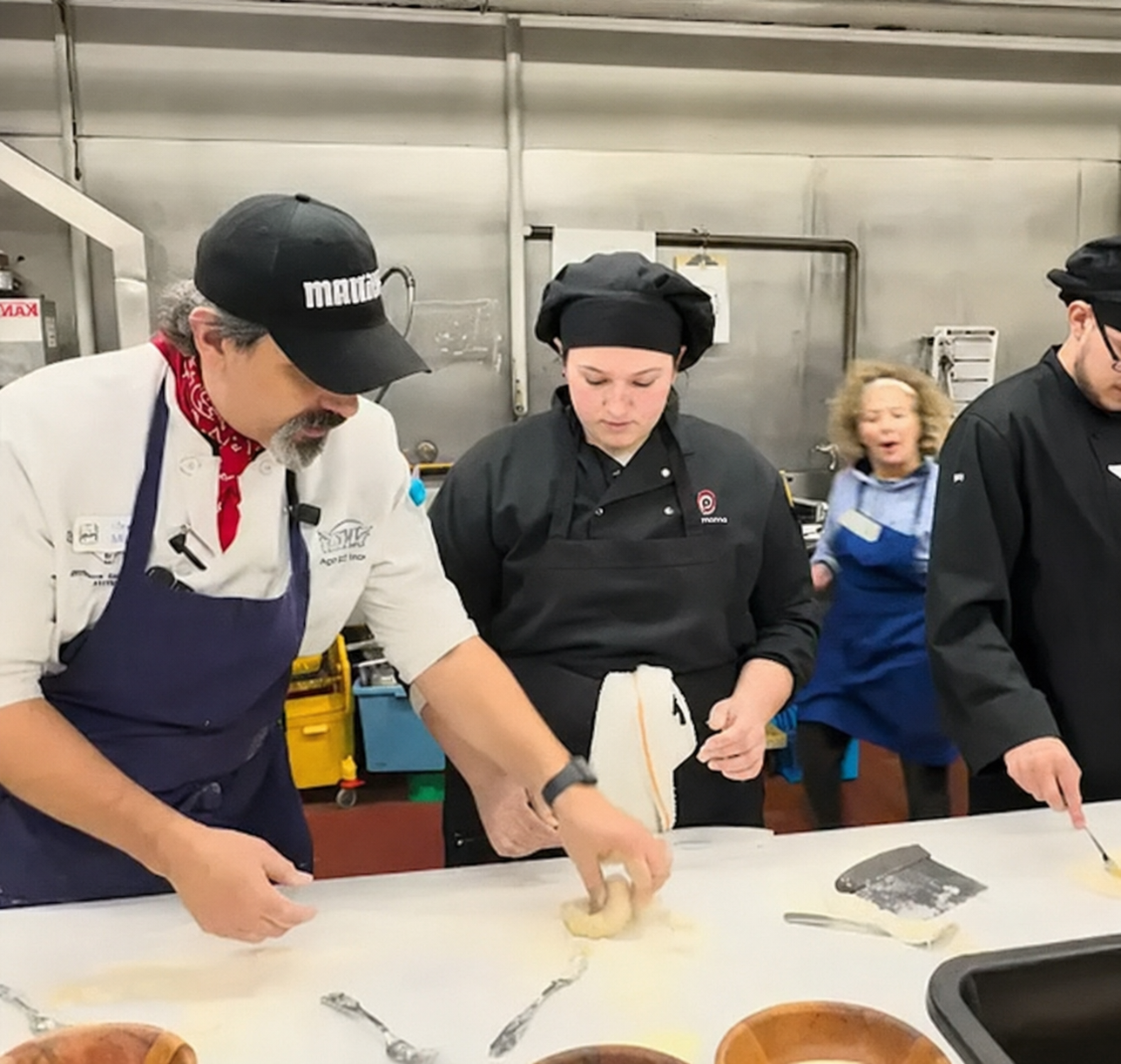
The spark
In 2020, while I was still running Spoon and Seed, Jeni Wheeler and I were working on parallel tracks. I was preparing meals for essential workers. She was helping vulnerable families through a local kitchen. We were responding to the same truth: food insecurity was not somewhere else. It was here, among our neighbors.
Jeni carried that commitment forward with Harry Henry and built Family Table Collaborative. I carried mine back into the classroom. When Spoon and Seed closed in 2024 and I became a culinary teacher at Cape Cod Regional Technical High School, those paths found each other again.
Then Deke Knight said four simple words: “Remember us at FTC.”
I did. What I saw was more than a volunteer opportunity. It was a working laboratory for everything I wanted students to understand: discipline, adaptability, ingredient respect, teamwork, service, and the responsibility that comes with feeding another person.
So we built the bridge. Junior and senior culinary students left the familiar rhythm of the school shop and entered a high-volume community kitchen where their work had an immediate destination.
What changed
The onions had to be cut consistently because hundreds of portions depended on them. Stations had to remain clean because meals were leaving the building. Communication mattered because students were working beside chefs, retirees, volunteers, and one another.
The kitchen became a place where technical skill and citizenship occupied the same cutting board.
weeks in the first program phase—long enough for a field trip to become a practice.
The learning
Applying ServSafe principles in a high-volume kitchen where every label, surface, and handoff matters.
Moving from classroom repetitions to consistent cuts across the quantities required for hundreds of meals.
Building stations, protecting the flow of work, and learning why an organized kitchen serves people better.
Giving clear direction, listening actively, and working alongside peers, chefs, and volunteers across generations.
Responding to changing ingredients and production needs without losing standards or momentum.
Treating surplus as possibility—reducing waste and using each ingredient with intention.
The larger lesson
The meals prepared at FTC do not disappear into a grade book. They travel to public distributions, councils on aging, veterans’ services, and neighbors who need something nourishing at the end of a difficult day.
Students see the entire system: donated surplus entering the kitchen, chefs and volunteers adapting the menu, teams cooking and packaging safely, and drivers carrying the work into the community. Waste becomes an ingredient. Technique becomes service.
“We were not practicing for someday. We were useful that day.”
Documented by Edible Cape Cod
In May 2026, writer Larry Egan captured the multigenerational FTC kitchen and the Cape Cod Tech students gaining real-world commercial experience inside it. The article shows what the program looks like when it is fully alive: students, chefs, and volunteers working side by side to turn surplus food into hundreds of future meals.
Read the Edible Cape Cod articleThe table
It rests on people willing to share their kitchen, their time, their standards, their ingredients, and their belief in young cooks.
Jeni Wheeler and Harry HenryFounders whose vision made Family Table Collaborative possible.
Deke KnightThe invitation back—and the distribution system connecting meals to neighbors.
Mary O’Keeffe and Chef Jim MillerOperational coordination, kitchen guidance, and mentorship.
Cape Cod Tech leadershipSupport for learning beyond the school walls.
Volunteers and food partnersIncluding Whole Foods Market, Hyannis, MA; Pain D’Avignon, Hyannis, MA; and Gustare, Chatham, MA.
What comes next
The first twelve weeks proved that culinary education can do more than prepare students for employment. It can strengthen a food system, connect generations, reduce waste, and make young people visible as contributors to their own community.
I want to keep refining the model—documenting the curriculum, measuring its impact, expanding paid pathways, and making it possible for other schools and community kitchens to build their own version.
Discuss an educational partnership